Trials, lawsuits and rights new
23 entries. The 1982 accident trial, lawsuits and credit disputes, sponsor censorship, and who has owned the franchise.
The 1982 helicopter accident on the set of Twilight Zone: The Movie killed Vic Morrow and two child actors and led to a manslaughter trial that ended in acquittals in 1987. Rights to the series passed from Cayuga Productions to CBS; writers disputed credits; and Serling fought sponsors over what he could say.
The 1982 accident and trial(7)
- Cal/OSHA safety citations after the Indian Dunes crash · Regulatory citation · 1982-09-30 · California Division of Occupational Safety and Health; Warner Bros.; the film production
About two months after the July 23, 1982 crash at Indian Dunes, California workplace-safety officials cited the production for safety violations. UPI reported the citations at the time.
- Child-labor violations in hiring Myca Dinh Le and Renee Chen · Child labor · 1982 · John Landis; George Folsey Jr.; Dan Allingham
The production hired the two children without the permits, the on-set teacher-welfare worker or the working-hour limits that California law required. The children were filmed late at night near explosives. Landis, Folsey and Allingham later admitted they had got around the child-labor rules, although nobody was prosecuted for the hiring itself.
- Industry safety reforms after the Twilight Zone accident · Safety reform · 1987 · FAA; California State Fire Marshal; Directors Guild of America; Screen Actors Guild; Warner Bros.
The FAA began requiring waivers for low-altitude helicopter filming. In 1987 California's State Fire Marshal set up a motion-picture safety program. The DGA and SAG introduced safety bulletins, hotlines and disciplinary rules, and Warner Bros. formed safety committees.
- NTSB probable-cause finding on the Twilight Zone helicopter crash · Investigation · 1984-10 · National Transportation Safety Board; Dorcey Wingo; John Landis
In October 1984 the NTSB found the probable cause of the crash to be special-effects explosions set off too close to a helicopter flying at low altitude. It added that the pilot and the director had failed to communicate and coordinate directly. The board also recommended extending film-flying rules to all types of aircraft.
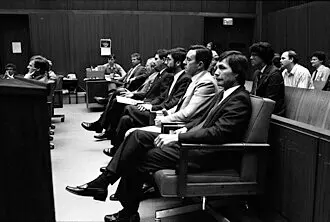
- People v. Landis et al. (Twilight Zone manslaughter trial) · Criminal trial · 1987-05-29 · John Landis; George Folsey Jr.; Dan Allingham; Dorcey Wingo; Paul Stewart; Deputy DA Lea Purwin D'Agostino
Director John Landis, associate producer George Folsey Jr., production manager Dan Allingham, helicopter pilot Dorcey Wingo and explosives specialist Paul Stewart were charged with involuntary manslaughter over the deaths of Vic Morrow, Myca Dinh Le and Renee Shin-Yi Chen.
- The Twilight Zone accident (1982) · History · 1982
On the night of July 23, 1982, while filming the Vietnam sequence of Twilight Zone: The Movie at the Indian Dunes ranch near Valencia, California, special-effects explosions damaged a low-flying helicopter, which crashed onto actor Vic Morrow and child actors Myca Dinh Le, 7, and Renee Shin-Yi Chen, 6, killing all three.
- The Twilight Zone manslaughter trial (1986-1987) · Trial · 1987
John Landis, associate producer George Folsey Jr., unit production manager Dan Allingham, helicopter pilot Dorcey Wingo and special-effects coordinator Paul Stewart were charged with involuntary manslaughter over the 1982 deaths of Vic Morrow, Myca Dinh Le and Renee Shin-Yi Chen.
Why it’s here: The legal aftermath of the deaths on the film's set.
Censorship(2)
- 'Noon on Doomsday' rewritten under sponsor pressure · Censorship · 1956-04-25 · Rod Serling; The United States Steel Hour; ABC; U.S. Steel
Serling wrote 'Noon on Doomsday' with the murder of Emmett Till in mind. After he mentioned this to Daily Variety, the broadcaster was flooded with protests and ordered changes: the story was moved to New England, the victim became an unnamed foreigner and every reference to the South was removed, including a Coca-Cola bottle.
- 'A Town Has Turned to Dust' moved to the 1870s Southwest · Censorship · 1958 · Rod Serling; Playhouse 90; CBS
For CBS's Playhouse 90, Serling wrote another drama drawn from the Till case. Under pressure from network executives it was set a century earlier in the Southwest, and its direct references to Black and white race relations were removed. NPR reported a 2008 staging of Serling's uncut version.
Lawsuits and credit disputes(11)
- Cal/OSHA safety citations after the Indian Dunes crash · Regulatory citation · 1982-09-30 · California Division of Occupational Safety and Health; Warner Bros.; the film production
About two months after the July 23, 1982 crash at Indian Dunes, California workplace-safety officials cited the production for safety violations. UPI reported the citations at the time.
- Child-labor violations in hiring Myca Dinh Le and Renee Chen · Child labor · 1982 · John Landis; George Folsey Jr.; Dan Allingham
The production hired the two children without the permits, the on-set teacher-welfare worker or the working-hour limits that California law required. The children were filmed late at night near explosives. Landis, Folsey and Allingham later admitted they had got around the child-labor rules, although nobody was prosecuted for the hiring itself.
- Civil suits by the Morrow, Le and Chen families · Civil suits · 1983 · Vic Morrow's family; families of Myca Dinh Le and Renee Shin-Yi Chen; Warner Bros.; the filmmakers
Vic Morrow's family settled their claims within about a year of the crash. The families of the two children brought several civil suits and recovered millions of dollars in total. The suits ran alongside the criminal case and were reported to be unusually complicated.
- Copyright claims over 'Sounds and Silences' and 'A Short Drink From a Certain Fountain' · Lawsuit · 1964 · CBS; unnamed claimants
Copyright infringement claims against these two fifth-season episodes, together with the 'Miniature' suit, caused all three to be left out of the original syndication package. With 'An Occurrence at Owl Creek Bridge' and 'The Encounter', they became the so-called 'lost five' episodes that fans could not see in reruns for years.
- Industry safety reforms after the Twilight Zone accident · Safety reform · 1987 · FAA; California State Fire Marshal; Directors Guild of America; Screen Actors Guild; Warner Bros.
The FAA began requiring waivers for low-altitude helicopter filming. In 1987 California's State Fire Marshal set up a motion-picture safety program. The DGA and SAG introduced safety bulletins, hotlines and disciplinary rules, and Warner Bros. formed safety committees.
- Licensing 'An Occurrence at Owl Creek Bridge' (La Rivière du hibou) · Licensing · 1964 · Robert Enrico; CBS; William Froug
For the fifth season the producers bought Robert Enrico's French short film, based on the Ambrose Bierce story, for about $20,000 instead of making a new episode. The deal allowed only two broadcasts, so the episode was missing from syndication until further rights were negotiated. It is now available on home video and streaming.
- 'Miniature' plagiarism suit ('The Thirteenth Mannequin') · Lawsuit · 1963 · Clyde Ware (per Plagiarism Today); CBS; Charles Beaumont
A writer who had sent the show a script called 'The Thirteenth Mannequin' sued, claiming that Charles Beaumont's 'Miniature' took his idea of a man drawn to lifelike figures. The court dismissed the case and the dismissal was upheld on appeal, partly because his script resembled Serling's earlier episode 'The After Hours'.
- NTSB probable-cause finding on the Twilight Zone helicopter crash · Investigation · 1984-10 · National Transportation Safety Board; Dorcey Wingo; John Landis
In October 1984 the NTSB found the probable cause of the crash to be special-effects explosions set off too close to a helicopter flying at low altitude. It added that the pilot and the director had failed to communicate and coordinate directly. The board also recommended extending film-flying rules to all types of aircraft.
- Plagiarism suits over 'Static' and 'Long Distance Call' · Lawsuit · 1961 · Charles Beaumont; William Idelson; unnamed writers; CBS
Not long after these two videotaped second-season episodes aired, other writers sued, saying they had written the stories before Beaumont (and, for 'Long Distance Call', Idelson). Both suits were settled out of court.
- Pseudonymous credits on Twilight Zone: The Movie · Credit · 1983 · Melissa Mathison; Andy House; Writers Guild; Directors Guild
Melissa Mathison, screenwriter of E.T., co-wrote the 'Kick the Can' segment under the pen name 'Josh Rogan'. After the accident, second assistant director Andy House had his credit replaced with the guild pseudonym 'Alan Smithee'.
- 'Where Is Everybody?' and Bradbury's 'The Silent Towns' · Credit dispute · 1959 · Rod Serling; Ray Bradbury; Carol Serling
Carol Serling noticed that the pilot episode resembled Ray Bradbury's 'The Silent Towns' from The Martian Chronicles. Serling admitted he had borrowed from it without meaning to and offered to pay for the rights. Bradbury said an acknowledgment was enough, and no payment ever followed.
Rights and ownership(3)
- Licensing 'An Occurrence at Owl Creek Bridge' (La Rivière du hibou) · Licensing · 1964 · Robert Enrico; CBS; William Froug
For the fifth season the producers bought Robert Enrico's French short film, based on the Ambrose Bierce story, for about $20,000 instead of making a new episode. The deal allowed only two broadcasts, so the episode was missing from syndication until further rights were negotiated. It is now available on home video and streaming.
- Marius Constant's fight for rights to the Twilight Zone theme · Music rights · 1997 · Marius Constant; CBS
Constant was paid about $200 to deliver a theme overnight, plus $500 if it was used, and his check took three months to arrive. He later sued and won rights to future earnings from the music, although not from past uses. The Seattle Times told the story in 1997.
- Serling sells his share of The Twilight Zone to CBS · Rights · 1964 · Rod Serling; Cayuga Productions; CBS
Serling's company, Cayuga Productions, co-owned the series with CBS. After the 1964 cancellation, Serling sold his share to the network, without foreseeing how valuable syndication would become. The rights stayed with CBS and passed into the Paramount corporate family, which still controls the series.
Media and content in Trials, lawsuits and rights (3)
Audio 1 · Images 2 · Media Library
- Images John Landis testifies (Herald Examiner photo, 1987) on People v. Landis et al. (Twilight Zone manslaughter trial)
- Images Defendants in court during the Twilight Zone manslaughter trial, John Landis at centre (1986) on The Twilight Zone manslaughter trial (1986-1987), John Landis +1
- Audio NPR - 50 years later, Rod Serling's play is performed (2008) on 'A Town Has Turned to Dust' moved to the 1870s Southwest